


Korea Zinc: Which Way Will the Voting Battle Go?
2024-11-12
The battle between the two sides is becoming increasingly intriguing. In a 5% shareholding disclosure filed on November 11, 2024, the Young Poong/MBK camp revealed that it had acquired an additional 1.36% stake in Korea Zinc, bringing its total stake to 39.83%. With stakes friendly to Chairman Choi Yun-beom estimated at 35.42%, treasury shares accounting for 12.14%, and the National Pension Service holding 7.75% (based on the number of shares held as of June 30), the free float (shares held by minority shareholders) amounts to just 5.24%.
The National Pension Service voted in favor of every company-proposed resolution at the annual general meeting on March 19, so it is expected to support management's proposals or abstain at subsequent shareholder meetings unless there is a particular reason to oppose them. Ultimately, the outcome of this battle will likely depend on how institutional and minority shareholders, who hold just 5.24%, exercise their voting rights in the coming showdown.
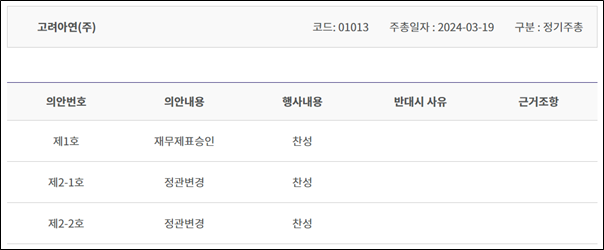
[National Pension Service Voting Record]
To help individual shareholders make their decisions, I have set out my thoughts from an independent professional perspective, free of any particular vested interests, based on the arguments each side has presented in news reports and other sources.
1. The Bad Guy vs. the Worse Guy
The moment Korea Zinc moved to issue new shares through a public offering after its tender offer to buy back its own shares, the prevailing view on who was worse seemed to shift toward Chairman Choi Yun-beom's camp. Not only was the move unprecedented, but it also sent the share price down to its daily lower limit. Even if it was legally permissible, I believe a sound legal adviser should have prevented this choice as a betrayal of shareholders' and the market's trust.
Korea Zinc's surprise decision to issue new shares ultimately prompted the Financial Supervisory Service (FSS) to investigate its legality. My guess is that the FSS's signature weapon—endless demands for amendments to securities registration statements—may eventually force Korea Zinc to withdraw the offering, but that, too, is only a prediction.

[The FSS Looks to Play Its Endless Merger Filing Amendment Card Against Doosan Group's Governance Restructuring]
But even if Korea Zinc does not withdraw the offering, the outcome is not predetermined. Economically, it is more rational for shareholders to exercise their voting rights to choose 'the person who will raise my share price in the future' rather than punish 'the bad guy who lowered my share price now.' Regardless of whether the offering is withdrawn, it is therefore crucial to examine who will lead the company well and raise its share price.
2. Is Corporate Value Likely to Suffer If MBK Takes Control?
It is inappropriate to label a fund predatory speculative capital simply because it is a private equity fund. There are clearly cases in which private equity funds have increased a company's value after acquiring it by improving governance and restructuring operations. At the same time, however, there are also fairly frequent cases in which private equity funds have acquired competitive companies and then weakened their competitiveness by selling core assets or taking excessive dividends.

[Predatory Speculative Capital vs. a Champion of Corporate Value Creation]
Like companies, private equity funds seek profits. However, whereas a company cannot pursue its own continuity, a company's continued existence is not in itself particularly important to a private equity fund. A private equity fund's overriding priority is to recover its principal plus its target internal rate of return, whether through dividends or a sale.
For a distressed, loss-making company, an operational overhaul may dramatically increase corporate value. But Korea Zinc is not in that position, so increasing its value enough to meet a minimum target internal rate of return of 15% a year is unlikely to be easy. MBK may therefore recover part of its investment by selling assets or borrowing money to fund large dividend payments.
For that reason, unless a company is receiving private equity investment because it needs to improve its financial position, I believe a private equity takeover is more likely to do the company harm than good.
3. Why Did Young Poong and MBK Join Forces?
My assessment of why Young Poong and MBK joined forces is as follows.
Although Young Poong is the largest shareholder, it does not have management control, so it cannot command a control premium even if it wishes to sell its stake. It would therefore be advantageous for Young Poong to secure control with an ally before selling.
Korea Zinc likely looked like an attractive target to MBK. It would have viewed the company as undervalued, with a solid financial structure, technological capabilities, and commercial strength. However, Korea Zinc's management had no intention of selling. MBK presumably partnered with Young Poong because it believed joining forces with the largest shareholder to secure control would be more economical than acquiring the company by paying Korea Zinc's management a substantial control premium.
4. What Vision Is MBK Offering?
I reviewed news articles and press releases but could not find how MBK intends to enhance Korea Zinc's corporate value. MBK's central argument is that 'the current management, whose managerial capabilities are unproven, is spending money like water, and Korea Zinc will struggle to cope with the pace of debt growth.' MBK expressed particular concern about investing more than 15 trillion won in borrowed funds in Korea Zinc's future growth strategy, Troika Drive, which covers renewable energy and hydrogen, rechargeable battery materials, and resource recycling.
Yet the market does not seem particularly concerned about Troika Drive, which Chairman Choi Yun-beom announced on December 30, 2021. Korea Zinc's closing share price that day was 511,000 won, and it continued trading sideways at a similar level until the recent tender offer.
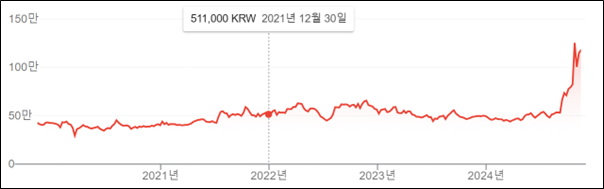
[Korea Zinc's Share Price Trading Within a Range for Three Years]
MBK argues that investment in new businesses such as Troika Drive, which are unlikely to become profitable for some time, inevitably depends on borrowing. Ultimately, this can only be interpreted as opposition to Troika Drive itself or to the scale of the initiative.
This is where shareholders need to exercise their own judgment. Can merely opposing investment in new businesses, or the scale of that investment, dramatically enhance the company's value? Or is investing in large-scale new businesses, even through borrowing, the better choice for securing future sources of earnings? This is a decision for each shareholder.
5. What Should Minority Shareholders Consider When Making Their Choice?
Minority shareholders' votes have become more important than ever in this battle for control. At this point, the two sides' positions and prospects can be summarized as follows.
MBK/Young Poong camp:
Securing financial stability by curbing excessive debt-funded investment in new businesses
Potential for higher dividends
However, no concrete plan presented for enhancing corporate value
Concerns about asset sales or excessive dividends as part of the investment exit process
Korea Zinc camp:
Securing future growth drivers through Troika Drive
Existing management's industry expertise and operational know-how
However, trust lost through a share offering that disregarded minority shareholders' interests
Financial risks associated with large-scale investment
Ultimately, minority shareholders must choose between the following two scenarios.
"Enhancing corporate value through stable management"
vs
"Securing long-term growth drivers through aggressive investment"
What matters here is not simply 'who is worse' but 'who can do more to increase the company's value.' Minority shareholders should give particular thought to the following three questions:
First, can Korea Zinc achieve sustainable growth with its current business portfolio alone?
Second, if entering new businesses through initiatives such as Troika Drive is unavoidable, are the timing and scale appropriate?
Third, which side's vision is more likely to be realized?
One thing is clear: this battle for control has made minority shareholders' voices more important in Korea's capital markets. I hope both sides use the remaining time to present more concrete, achievable visions that can win minority shareholders' support.