


Proxy Advisers and the National Pension Service Have Decided—What Will the Final Outcome Be?
2025-01-20
The long, drawn-out battle is nearing its end.
With the decisive shareholders’ meeting scheduled for 9 a.m. on Thursday, January 23, 2025, the major proxy advisory firms and the National Pension Service all finalized their positions last week.
On cumulative voting, the biggest issue on the agenda, institutions have taken differing positions.
Starkly different decisions across institutions
ISS and the Korea Institute of Corporate Governance and Sustainability (formerly the Korea Corporate Governance Service) opposed the introduction of cumulative voting, while Glass Lewis, the Korea ESG Research Institute (formerly the Daishin Economic Research Institute), Sustinvest, and the National Pension Service supported it.
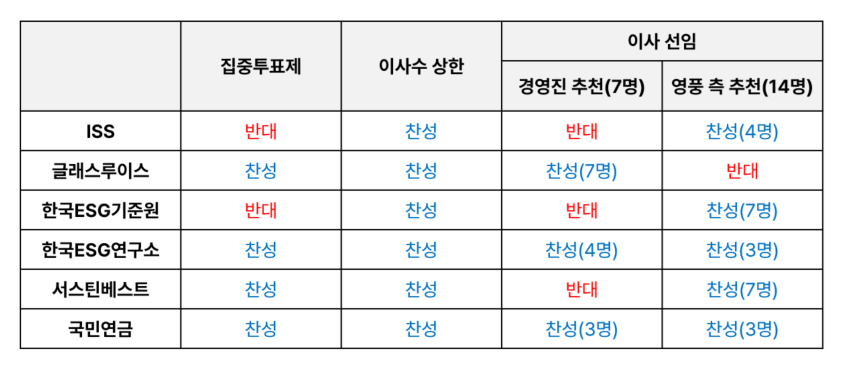
ISS opposed the introduction of cumulative voting, stating, “Although cumulative voting is generally understood to serve minority shareholders’ interests, in this case it could have the unintended consequence of diluting the changes sought by the dissident side,”
Glass Lewis described cumulative voting as “positive in that it can protect minority shareholders’ rights and reflect shareholders’ diverse views on board composition,” concluding that the benefit of “establishing safeguards for small shareholders” outweighed the potential drawbacks of its introduction.
Korea Zinc’s purpose in playing the cumulative voting card during a battle for control is clear. Still, individuals and institutions may interpret its future benefits for minority shareholder rights differently, so this diversity of conclusions is, in some respects, only natural.
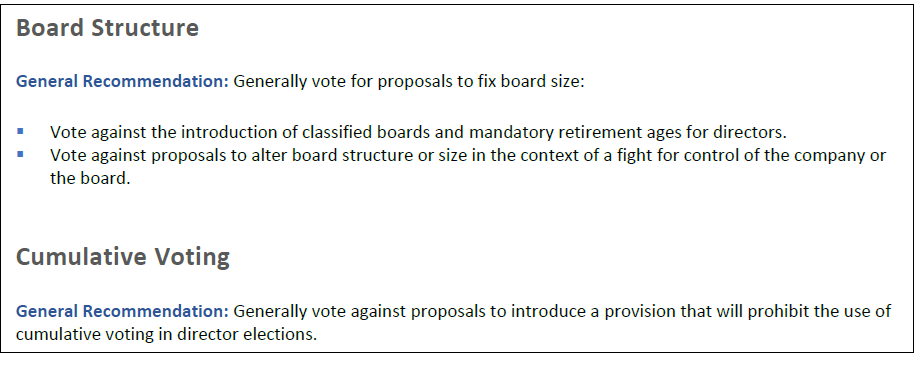
Notably, ISS is the only institution with guidelines explicitly opposing amendments to the articles of incorporation that change the number of directors during a battle for control. This can be understood as opposition to changing the rules of the contest while it is underway. From this perspective, its attempt to block Korea Zinc’s decision to introduce cumulative voting during the control dispute is understandable to some extent.
However, as noted in our previous column, HeyHolder supports the introduction of cumulative voting as a reform that benefits minority shareholders, regardless of the motives behind it.
Shareholdings on Chairman Choi Yun-beom’s side are already dispersed to some extent, so relatively few voting rights are restricted by the 3% rule. Unless the National Assembly passes separate legislation, missing this opportunity could therefore make it impossible ever to introduce cumulative voting. Given the significance and importance of the Korea Zinc control dispute for Korea’s capital markets, cumulative voting must be introduced.
For reference, according to the Korea Fair Trade Commission, only 13 of the 344 listed companies belonging to large business groups with assets of at least KRW 5 trillion have adopted cumulative voting. Most of these companies, such as POSCO Holdings, Korea Electric Power Corporation, and KT, have no controlling shareholder.
The National Pension Service also backs cumulative voting
The National Pension Service’s Expert Committee on Stewardship Responsibilities also held its first meeting on January 17 and voted in favor of amending the articles of incorporation to remove the provision excluding cumulative voting, presumably for reasons similar to those outlined above.
With the National Pension Service holding a 4.5% stake in Korea Zinc, its position has rightly drawn everyone’s attention, but that does not mean the outcome of this battle is already settled. In this precariously balanced proxy contest, the outcome could swing completely depending on whether any shareholders friendly to Chairman Choi Yun-beom break ranks and how the remaining foreign and domestic institutions vote. We will have to wait patiently for the result until Thursday’s shareholders’ meeting is over.