

What Lies Ahead for Korea Zinc’s Upcoming Annual General Meeting
2025-03-26
Korea Zinc’s annual general meeting is now just two days away.
With annual general meeting season underway, the meeting appears to be attracting relatively less media and public attention than the extraordinary general meeting held in January.
This appears to reflect a widespread view in the market that the National Pension Service and institutional investors will find it difficult to support MBK in this case as well. Controversy over MBK’s management practices has intensified following its recent filing to place Homeplus in corporate rehabilitation proceedings, and these investors cannot ignore the public’s cold attitude toward MBK.
The sale of commercial paper (CP) to retail investors before the rehabilitation filing dealt a devastating blow to MBK’s ethical standing, and Financial Supervisory Service Governor Lee Bok-hyun also followed with sharp criticism of MBK.
Public Sentiment Turns Against MBK
The National Pension Service has entered into private equity fund management agreements with MBK since 2011 and has committed approximately KRW 2 trillion to date. The problem is that it was confirmed to have invested approximately KRW 600 billion in the “MBK Fund III blind-pool fund,” which acquired Homeplus, raising questions about the National Pension Service’s own responsibility.
The National Pension Service reportedly spent considerable time deliberating additional commitments to MBK starting last year, before committing approximately KRW 300 billion last month on the condition that the additional funds would not be used in the battle for control of Korea Zinc.
I will discuss MBK’s management practices in greater detail in a separate article. Here, I would like to offer a professional perspective on legal issues surrounding this annual general meeting that may be somewhat difficult for non-specialists to understand but may nevertheless pique their interest.
Legal Disputes at the Annual General Meeting
There are two main issues at this annual general meeting: whether Young Poong will be able to exercise its voting rights, and how many directors Korea Zinc and Young Poong will each have elected from among the 19 candidates.
At the previous extraordinary general meeting, Korea Zinc completely blocked Young Poong from exercising its voting rights by establishing a cross-shareholding relationship. Earlier this month, Sun Metals Corporation (SMC) distributed its 10.3% stake in Young Poong as a dividend in kind to Sun Metals Holdings (SMH), Korea Zinc’s Australian subsidiary, signaling its intention to restrict Young Poong’s voting rights at this annual general meeting as well on the grounds of cross-shareholding.
In response, Young Poong immediately applied to the Seoul Central District Court for an injunction allowing it to exercise its voting rights. The court is expected to reach a decision before the 27th, the day before the shareholders’ meeting.
You may wonder why this is an issue when the record date for the annual general meeting was December 31, 2024, at which time there was no cross-shareholding relationship between Young Poong and Korea Zinc. The reason is that the Supreme Court has previously ruled that voting rights are unavailable if the cross-shareholding requirements are met on the actual date of the shareholders’ meeting, even if they were not met on the record date (Supreme Court judgment of January 30, 2009, Case No. 2006Da31269).
Korea Zinc argues that although Young Poong plans to exercise voting rights attached to its 25.42% stake at the annual general meeting on the 28th, it cannot do so because Korea Zinc’s subsidiary Sun Metals Holdings will hold a 10.3% stake in Young Poong on the day of the meeting. In contrast,
Young Poong maintains that no cross-shareholding relationship existed as of the record date, December 31, 2024, because neither Korea Zinc nor its subsidiaries held shares in Young Poong at that time. It also argues that, as of the annual general meeting date of March 28, 2025, the holder of the Korea Zinc shares is YPC, a limited company wholly owned by Young Poong, and that cross-shareholding rules do not apply to limited companies. It therefore considers that no cross-shareholding relationship exists and that there is no basis for exercising voting rights.
There are no precedents or comparable cases to consult, and both sides’ arguments are persuasive to some extent, making it impossible to predict how the court will rule.
Although this has not been reported in the media, if Korea Zinc has challenged the validity of Young Poong’s contribution of its Korea Zinc shares to YPC in kind during the injunction proceedings, I believe this could present a significant legal issue.
Does the Transfer of Korea Zinc Shares Require a Special Resolution at a Shareholders’ Meeting?
Under the Commercial Act, a company must obtain a special resolution at a shareholders’ meeting to transfer all or a material part of its business, and a business transfer made in violation of this requirement is invalid. In determining what constitutes a “material part of a business,” courts must comprehensively consider factors such as the proportion of the company’s total business accounted for by the assets, sales and earnings of the business being transferred, as well as the impact that transferring part of the business will have on the company’s future scale of operations and profitability (Supreme Court judgment of October 15, 2014, Case No. 2013Da38633).
In practice, consistent with the thresholds for filing a material event report, a transaction is treated as a business transfer requiring a special resolution at a shareholders’ meeting if the assets of the business division being transferred, measured at the higher of book value or transaction value, and its sales represent at least 10% of the transferring company’s total assets and sales, respectively. These figures are measured on a consolidated basis as of the end of the latest fiscal year, here and below.
The issue with asset transfers is that transferring important assets that underpin a stock corporation’s continued existence causes its business to cease or be suspended. As this is no different from transferring all or part of a business, a special resolution at a shareholders’ meeting is required in such cases.
In one Supreme Court case involving the sale of a stake in a subsidiary to an outside party, the stake represented one-quarter of the company’s assets. The Court held that the transfer required a special resolution at a shareholders’ meeting because the stake was effectively the company’s only asset with substantive value.
Young Poong appears to argue that its Korea Zinc shares are an investment in an associate rather than a stake in a controlled company, or subsidiary, and that no special resolution at a shareholders’ meeting is required because there is no change in its business structure. Given the significance of the Korea Zinc shares to Young Poong, however, it is somewhat questionable whether the court will accept that argument at face value.
For reference, Young Poong contributed a total of 5.26 million Korea Zinc shares in kind, with a transfer value of KRW 3.9265 trillion. This represents 70% of its total assets of KRW 5.5681 trillion and 91% of its equity of KRW 4.2827 trillion.
Young Poong received approximately KRW 280 billion in dividends from Korea Zinc over the past three years. Considering that Young Poong’s cumulative operating losses over the same period were approximately KRW 260 billion and its cumulative net income was just approximately KRW 4.3 billion, its stake in Korea Zinc is clearly a highly important asset in its own right.
If the share transfer requires a special resolution at a shareholders’ meeting because it is equivalent to a business transfer, it does not matter whether the shares were sold to a third party or contributed in kind to a wholly owned subsidiary. If a contribution in kind to a wholly owned subsidiary were deemed not to require a special resolution because it does not change the business structure, that would mean the shares could first be contributed to a subsidiary and then sold to a third party with only the parent company’s approval. That would produce an unreasonable outcome.
The Positions of the Proxy Advisory Firms
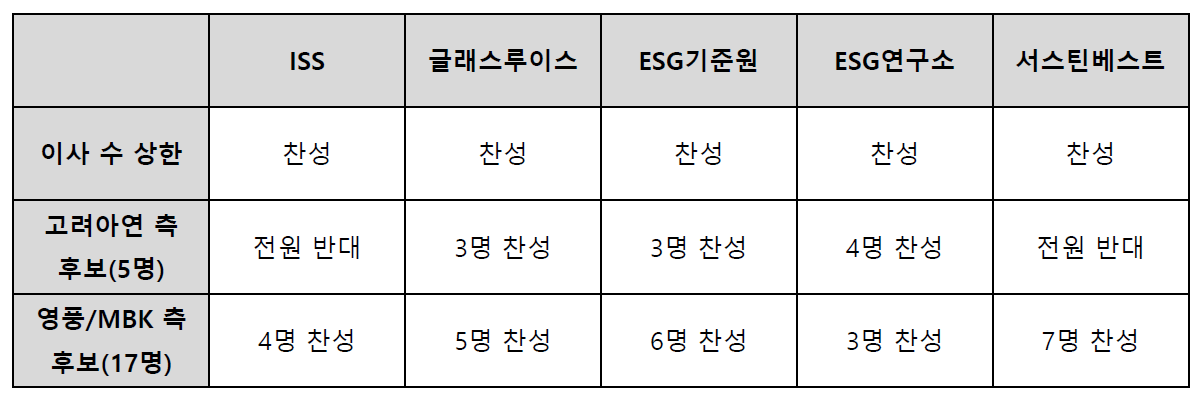
Most institutional investors are expected to vote in favor of amending the articles of incorporation to cap the number of directors at 19, in accordance with the stewardship code. However, if Young Poong is permitted to exercise its voting rights, the Young Poong–MBK camp will hold a combined 40.9% stake. As long as they oppose the amendment, the requirements for a special resolution cannot be met, making the amendment unlikely to pass.
Interestingly, several proxy advisory firms have emphasized the need to change the current board’s composition and recommended voting against Korea Zinc’s nominees, while also opposing MBK Vice Chairman Kim Kwang-il and Young Poong President Kang Sung-doo because of the recent Homeplus crisis and recent safety accidents at Young Poong.
This is understandable at first glance. But if the Homeplus crisis and safety accidents at Young Poong are grounds for opposition, I wonder whether it would be more appropriate in practice to oppose not only Vice Chairman Kim Kwang-il and Young Poong President Kang Sung-doo, but also a substantial number of the candidates nominated by MBK and Young Poong.
Of course, each director is supposed to exercise independent judgment, but in reality even outside directors whose independence is recognized often serve as little more than rubber stamps. People whose experience, reputation and social standing seem impeccable very rarely challenge improper corporate decisions once they become outside directors. From this perspective, it may be worth considering Italian company law, which provides for slate voting “based on lists proposed by shareholders.”
There are now two days left. Only the positions of the court and the National Pension Service remain to be seen. It will be worth watching closely to see whether this annual general meeting ends the battle or leads to another one.