

The Korea Zinc Control Dispute Viewed Through the Homeplus Crisis
2025-03-26
Lee Gyu-seong, an attorney specializing in corporate law who previously worked on Merrill Lynch Securities’ equity research team, examined the economic and industrial implications of the dispute over control of Korea Zinc through a case study.
In particular, looking at the series of management actions that MBK Partners (hereinafter “MBK”) took after acquiring Homeplus and their outcomes, he considered how an acquisition of Korea Zinc by MBK might affect the company and South Korea’s minerals industry.
1. MBK’s Acquisition of Homeplus and Management Failures – A Detailed Case Analysis
MBK attracted media attention when it acquired Homeplus from the UK’s Tesco in 2015. However, MBK’s subsequent management undermined Homeplus’s fundamental competitiveness and led to a sharp decline in corporate value and market confidence.
(1) A Management Strategy Centered on Monetizing Real Estate Assets
After acquiring Homeplus in 2015, MBK focused on recouping its investment by monetizing Homeplus’s real estate assets. In particular, it was found to have sold or monetized approximately KRW 4.113 trillion in assets between 2016 and 2023.
These asset sales included key Homeplus stores. For example, the Bucheon Sangdong store, known as the company’s top-selling store nationwide, and the Ansan store, which ranked among the top five in sales, were among those slated for sale. These stores have either closed or are awaiting closure.
Homeplus’s revenue was approximately KRW 7.9 trillion at the time of MBK’s acquisition in 2016, but it declined steadily thereafter, falling to approximately KRW 6.7 trillion in 2024. Despite inflation and national economic growth over that period, revenue fell 15% compared with 10 years earlier, reflecting various factors, including store closures and the expansion of the online market.
As revenue declined, operating profit naturally fell as well. Operating profit stood at a healthy level of approximately KRW 32 billion in 2016, but then dropped sharply, turning into an operating loss from 2020 onward.
While operating indicators deteriorated as described above, borrowings rose sharply from 2020 onward and have remained at approximately KRW 8.5 trillion. This reflects structural problems arising from MBK’s leveraged buyout strategy and sale-and-leaseback (S&LB) arrangements.
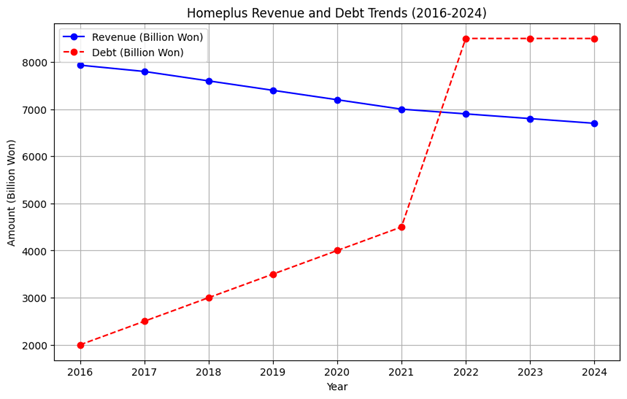
As the graph above clearly shows, both revenue and profitability deteriorated after MBK acquired Homeplus, while reliance on borrowing increased substantially. These financial difficulties were major factors behind Homeplus’s recent filing for corporate rehabilitation proceedings.
(2) Store Reductions and Worsening Job Insecurity
Under MBK’s management, Homeplus has steadily reduced its nationwide store count, resulting in numerous permanent employees and employees of partner companies losing their jobs. According to the Homeplus labor union, MBK carried out restructuring to cut costs, leading to poorer service quality and customer losses.
According to the Financial Supervisory Service’s electronic disclosure system and the Mart Industry Labor Union, Homeplus has made the largest reductions in stores and employees among hypermarket chains in the 10 years since MBK’s acquisition. Homeplus’s store count fell from 142 at the time of the acquisition in September 2015 to 126 as of March 2025. This contrasts with competitors E-Mart and Lotte Mart, whose store counts declined by 2 and 6, respectively, over the same period.
Homeplus also recorded the largest reduction in employees. According to workplace data from the National Pension Service, Homeplus’s headcount declined by a net 6,079 between 2015 and December 2024. Over the same period, the net reductions at E-Mart and Lotte Mart were 5,604 and 3,570, respectively.
These figures show how MBK’s asset-sale strategy led to Homeplus store closures and reduced employment. Given the impact of this management approach on corporate sustainability, concerns may arise over MBK’s future acquisitions of other companies.
In the Homeplus case, MBK may have temporarily improved short-term profitability, but over the long term, it undermined fundamental measures of retail competitiveness, including revenue growth potential, job creation, distribution networks, and logistics efficiency.
(3) A Lack of Long-Term Strategy and Excessive Efforts to Recoup Investment
MBK invested approximately KRW 7 trillion when it acquired Homeplus. Recently, however, Homeplus fell into a liquidity crisis and filed with the court for corporate rehabilitation proceedings on March 4, 2025. As a private equity firm, MBK’s structure inevitably requires it to focus on recouping its investment. With Homeplus entering corporate rehabilitation proceedings, executives and employees, business partners, and corporate bond investors have suffered widespread harm.
- Harm to business partners holding trade receivables: In corporate rehabilitation proceedings, trade claims that do not qualify as common benefit claims—namely, those arising more than 20 days before proceedings commence—are assigned a lower repayment priority. Small and medium-sized enterprises and small business owners inevitably face cash-flow constraints if these amounts are not paid on time.
- Harm to corporate bond investors: Homeplus reportedly sold approximately KRW 600 billion in short-term debt securities up until just before filing for corporate rehabilitation, of which approximately KRW 200 billion was sold to individual investors. These securities are classified as rehabilitation claims in the proceedings and have a low repayment priority, so investors are expected to face difficulties recovering their principal.
2. Korea Zinc’s Fundamental Business Structure and Its Incompatibility with MBK
Korea Zinc is a company in one of South Korea’s foundational industries, with world-class technology in nonferrous metal smelting and a stable earnings structure. Its longstanding conservative, technology-focused management, capital investment strategy centered on environmental protection and safety, and raw-material procurement system based on global networks fundamentally conflict with the operating approach of private equity funds that pursue only short-term returns.
If MBK acquires Korea Zinc, the Homeplus case suggests that the following outcomes could occur.
(1) Reduced Technology Investment and Delays in Environmental Facilities
Korea Zinc has focused on meeting environmental standards and improving smelting efficiency through annual capital expenditures (CAPEX) totaling hundreds of billions of won. It operates a proprietary integrated process that extracts 12 scarce and rare metals, including indium, tellurium, and antimony, present in trace amounts in zinc, lead, and copper concentrates.
Its business model maximizes resource utilization and profitability by recovering additional metals from residues that other smelters typically discard. In particular, the integrated zinc-lead-copper process that boosts the company’s profit margins is proprietary to Korea Zinc. Long-term investment in the Onsan Smelter has also improved operating processes and energy efficiency, strengthening cost competitiveness and raising operating margins. Korea Zinc recorded an operating margin of 10.1% in 2024 based on its annual separate financial statements. Double-digit operating margins are uncommon in large-scale manufacturing. This is the product of decades of investment and R&D.
According to a February 2025 report by Korea Investors Service, Korea Zinc made the capital expenditures shown in the following table from 2019 through September 2024.
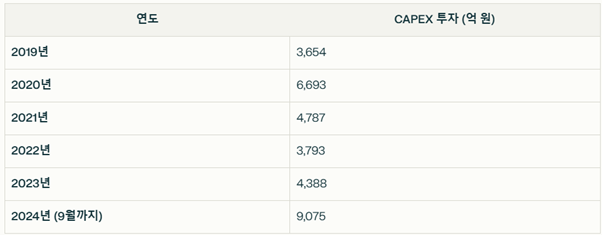
However, as a financial investor, MBK is likely to focus on monetizing company assets and cutting costs rather than maintaining such ongoing capital investment. This is because MBK’s inherent business model requires it to resell Korea Zinc after acquiring it. Over the long term, this could erode Korea Zinc’s technological competitiveness.
(2) Workforce Restructuring and the Departure of Key Talent
Korea Zinc operates in an industry where highly skilled technical personnel are directly linked to productivity. If MBK gains management control, it could carry out restructuring to reduce labor costs, as it did while managing Homeplus. This could lead to the departure of skilled employees and threaten the stability of production operations.
3. MBK’s Acquisition of Korea Zinc Would Be Merely an “Intermediate Stop.”
Given MBK’s management approach, an acquisition of Korea Zinc would likely be premised on “recouping short-term returns and then selling” rather than “long-term ownership.” As a private equity firm, MBK operates on the assumption that it will recoup its investment through an exit at some point, generally through corporate breakups, restructuring, asset sales, or sales to third parties.
If MBK acquires Korea Zinc, it is likely to take steps to maximize short-term profitability and then sell the company to another private equity fund or foreign investors. The problem is that Korea Zinc is not merely a private company.
It is one of the key companies in South Korea’s foundational minerals-related industries. The company should be led by management that exercises responsibility toward the industry and pursues sustainable management, rather than by investors seeking only short-term returns. With MBK’s responsibility now under scrutiny following the Homeplus crisis, there are serious concerns about allowing Korea Zinc to follow the same path.
If management misjudgments cause Korea Zinc to lose its fundamental business competitiveness, the company’s profitability will deteriorate and the funds available for shareholder returns will shrink, ultimately causing losses for numerous shareholders. Shareholder-friendly management policies are important, but the first priority is for the company to run its business well and generate profits that can be returned to shareholders.
4. Conclusion
MBK’s attempt to gain management control is not simply an investment issue; it concerns the sustainability of South Korea’s minerals industry. Korea Zinc’s current management has been ungenerous in providing returns to minority shareholders, and there have clearly been shortcomings. Indeed, Korea Zinc’s share price was in the KRW 400,000 range in March 2015, 10 years ago, and was only in the KRW 500,000 range before the dispute over management control with Young Poong arose in 2024. However, it is undeniable that, over that period, Korea Zinc’s management improved the company’s profitability by strengthening its fundamental business competitiveness through a long-term, technology-focused management approach.
The answer to whether we should entrust our nation’s foundational industries to outside investors pursuing short-term returns is clear. For these reasons, I wish to express concern over MBK’s attempt to acquire Korea Zinc and make clear my position that Korea Zinc’s current management must operate the company with a long-term vision and share the resulting profits equitably with all of its shareholders.