


Understanding the Amended Commercial Act
2025-07-23
1. Introduction
The amendments to the Commercial Act have finally been promulgated, just 19 days after the bill to partially amend the Act passed a plenary session of the National Assembly on July 3, 2025.
These amendments focus on limiting major shareholders’ voting rights and ensuring that minority shareholders can effectively exercise their participation rights. An earlier attempt to amend the Commercial Act fell through when the acting president exercised the veto power early this year. With the inauguration of the new administration, however, a more refined version has cleared both the legislature and the executive branch.
Following discussions between the ruling and opposition parties, the amendments include ▲ introducing a duty of loyalty for directors to protect shareholders’ interests, ▲ making electronic general meetings of shareholders mandatory, and ▲ introducing an independent director system. They also extend the rule aggregating the holdings of the largest shareholder and its related parties when applying the 3% voting cap to audit committee members who are outside directors, to whom this aggregation rule did not apply under the previous Commercial Act. The provision on directors’ duty of loyalty takes effect immediately upon promulgation. Mandatory electronic general meetings of shareholders take effect on January 1, 2027, while the independent director system and the expanded 3% voting cap take effect after a one-year grace period.
Meanwhile, the ruling and opposition parties agreed to exclude from the final version two provisions included in the original bill: ▲ mandatory cumulative voting at large listed companies and ▲ increasing the number of audit committee members elected separately from other directors (from 1 to 2 or more). These matters will, however, be discussed further through public hearings, so legislative developments will need to be monitored.
This column examines how the enhanced rights secured for minority shareholders by these amendments can serve as practical tools for improving corporate governance and increasing shareholder value.
2. Expanding Directors’ Duty of Loyalty: Toward Shareholders, Not Just the Company
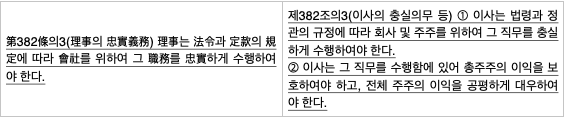
The most notable change introduced by these amendments is the explicit extension of directors’ duty of loyalty beyond the “company” to include “shareholders.”
The previous Commercial Act provided only that “directors must perform their duties toward the company with the care of a prudent manager,” making it difficult for shareholders to claim harm unless the company itself had suffered a loss. The Supreme Court likewise took the position that directors, as persons handling the company’s affairs, owed duties of care and loyalty only to the company. Because directors were not in a position to handle the affairs of individual shareholders directly, who are legally distinct from the company, the Court generally held that directors did not owe shareholders a duty of loyalty.
The amended Commercial Act, however, expressly states that “directors must faithfully perform their duties for the company and its shareholders, protect the interests of all shareholders, and treat them equitably.” This means that when management makes decisions involving potential conflicts of interest, such as mergers between affiliates, corporate divisions, or treasury share transactions, it must consider the impact on the interests of shareholders as a whole.
For example, where a merger ratio is unfair or a share issuance dilutes small shareholders’ holdings, directors will now find it harder to avoid liability simply by arguing that “the company suffered no loss.” In effect, this opens the way for minority shareholders to pursue directors’ liability more actively through shareholder derivative actions, direct actions, and other means.
Moreover, with directors’ “duty of loyalty to shareholders” now expressly stipulated by law, legal disputes may arise over whether directors are directly liable to shareholders for damages and, if so, the scope of that liability. In particular, significant changes to established practices may be required in capital transactions and restructuring decisions, such as listing a subsidiary created through a vertical spin-off, setting unfair merger ratios, issuing new shares or disposing of treasury shares to specific parties, or squeezing out minority shareholders.
However, the wording of the amended Commercial Act alone makes it difficult to determine precisely what steps directors must take to protect shareholders’ interests. The interpretation of these provisions will therefore likely need to be clarified over time through academic and professional discussions and court decisions.
3. From Outside Directors to Independent Directors and a Higher Mandatory Proportion: More Than a Name Change
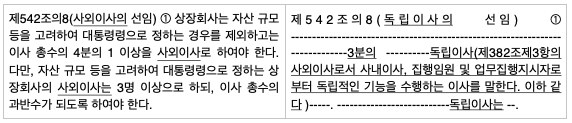
The second change is that listed companies’ “outside director” system is becoming an “independent director” system. This is more than a change in terminology: these directors’ roles and responsibilities have been substantially strengthened so that they can genuinely protect shareholders’ interests free from the influence of major shareholders or management.
Outside directors have long been criticized for being “outsiders” only on paper, while in practice their interests were intertwined with those of the largest shareholder or management, making it difficult for them to provide independent oversight within the board. The amendments expressly establish a legal requirement that independent directors participate in corporate decision-making from a position of substantive independence from inside directors, executive officers, and persons who direct the conduct of company business, rather than merely being external appointees.
This is seen as clarifying the legal basis for shareholders to thoroughly review independent director candidates’ backgrounds and interests and, where necessary, use shareholder proposals to oppose candidates who lack independence or put forward alternatives.
4. Expanding the 3% Rule for Audit Committee Members: Also Applicable to the Appointment and Removal of Independent Directors
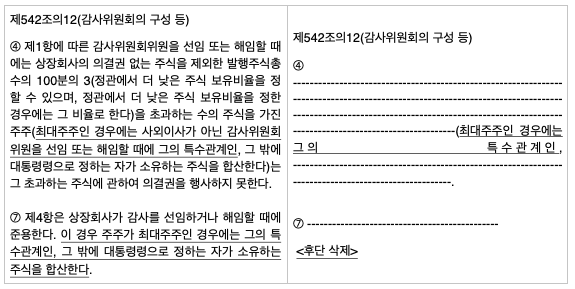
The third change closes off a structure that had allowed the largest shareholder to effectively dominate internal controls through a listed company’s audit committee.
Listed companies with assets above a certain threshold must establish an audit committee. Under the previous Commercial Act, when appointing or removing audit committee members who were “outside directors,” the largest shareholder and its related parties could each exercise voting rights of up to 3%, without aggregating their shareholdings. By contrast, for audit committee members who were “not outside directors,” the holdings of the largest shareholder and its related parties were aggregated, with their combined voting rights capped at 3%. Most companies therefore chose to appoint audit committee members who were outside directors, preserving the largest shareholder’s influence.
Under the amendments, however, the largest shareholder’s holdings will be aggregated with those of its related parties and subject to a combined voting cap of 3% even on resolutions to appoint or remove audit committee members who are outside directors (independent directors).
This gives activist funds and coalitions of small shareholders a greater chance of directly nominating audit committee candidates in opposition to major shareholders and securing their appointment. Minority shareholders can also consolidate their dispersed holdings to secure a casting vote in contested votes, giving them leverage to negotiate with management and exercise meaningful influence.
These changes will provide an important foundation for structural checks on major shareholders’ unchecked control and for more transparent and accountable corporate governance, enabling minority shareholders to exercise meaningful oversight of management.
5. Mandatory Electronic General Meetings: Exercising Voting Rights Through Real-Time Participation and Enhancing Transparency
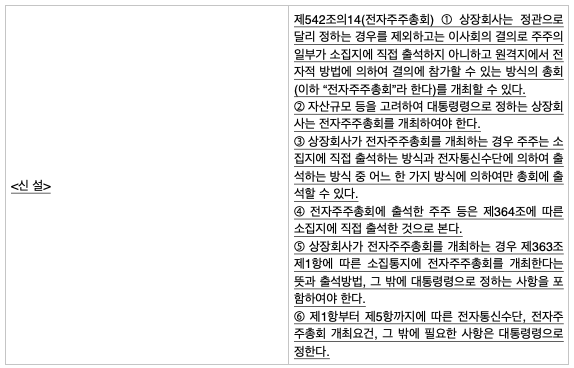
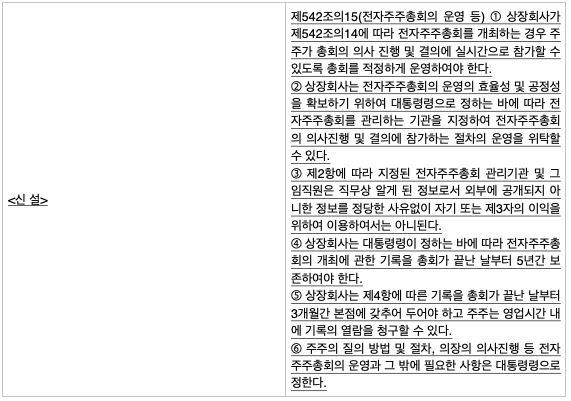
The fourth change requires listed companies above a certain size to hold electronic general meetings of shareholders. Until now, the Commercial Act had required shareholders to attend general meetings in person, making it practically difficult for shareholders living abroad or small shareholders in distant locations to attend and exercise their voting rights. Some listed companies had tried electronic voting or online broadcasts, but shareholders could generally only watch on screen, with limited ability to vote in real time or exchange views with management. Most arrangements therefore offered little more than an opportunity to observe.
Under the amendments, shareholders attending an electronic general meeting remotely are deemed to have attended in person.Notices convening general meetings must also state that the meeting will be held electronically and provide specific instructions on how to attend. After the meeting, comprehensive records of the proceedings and resolutions must be retained for 5 years. Shareholders may inspect these records at the company’s head office for 3 months after the meeting ends, allowing them to verify the transparency of the voting process firsthand.
In particular, the amendments provide for shareholders to ask questions about agenda items, express their views, and exercise their voting rights in real time at electronic general meetings. These stronger participation rights and improved access to information will help general meetings function properly as a key corporate governance control mechanism.
6. Conclusion
These amendments to the Commercial Act will bring substantial changes to nearly every major corporate decision, including restructuring, investment, strategy, finance, and IR (investor relations). In particular, the newly explicit duty of directors to protect not only the company’s interests but also those of shareholders means that management will have to pay closer attention to procedural fairness and transparency throughout every decision-making process.
Going forward, shareholders will be able to examine for themselves whether directors have actually fulfilled their duty to protect shareholders’ interests in various decisions and, where necessary, hold them accountable through shareholder derivative actions or criminal complaints for breach of trust. Mandatory electronic general meetings will lower barriers to participation, while the strengthened independent director system will enhance transparency in board composition and improve oversight. Shareholders will be able to scrutinize not only the exercise of voting rights but also proxy solicitations and the entire IR process more closely, raising concerns and actively making their voices heard when necessary.
The shareholder rights strengthened by these amendments will provide a solid foundation for improving both management transparency and shareholder value. When we all safeguard and properly exercise these rights, companies will be able to grow on a sounder footing, supported by shareholders’ trust.