

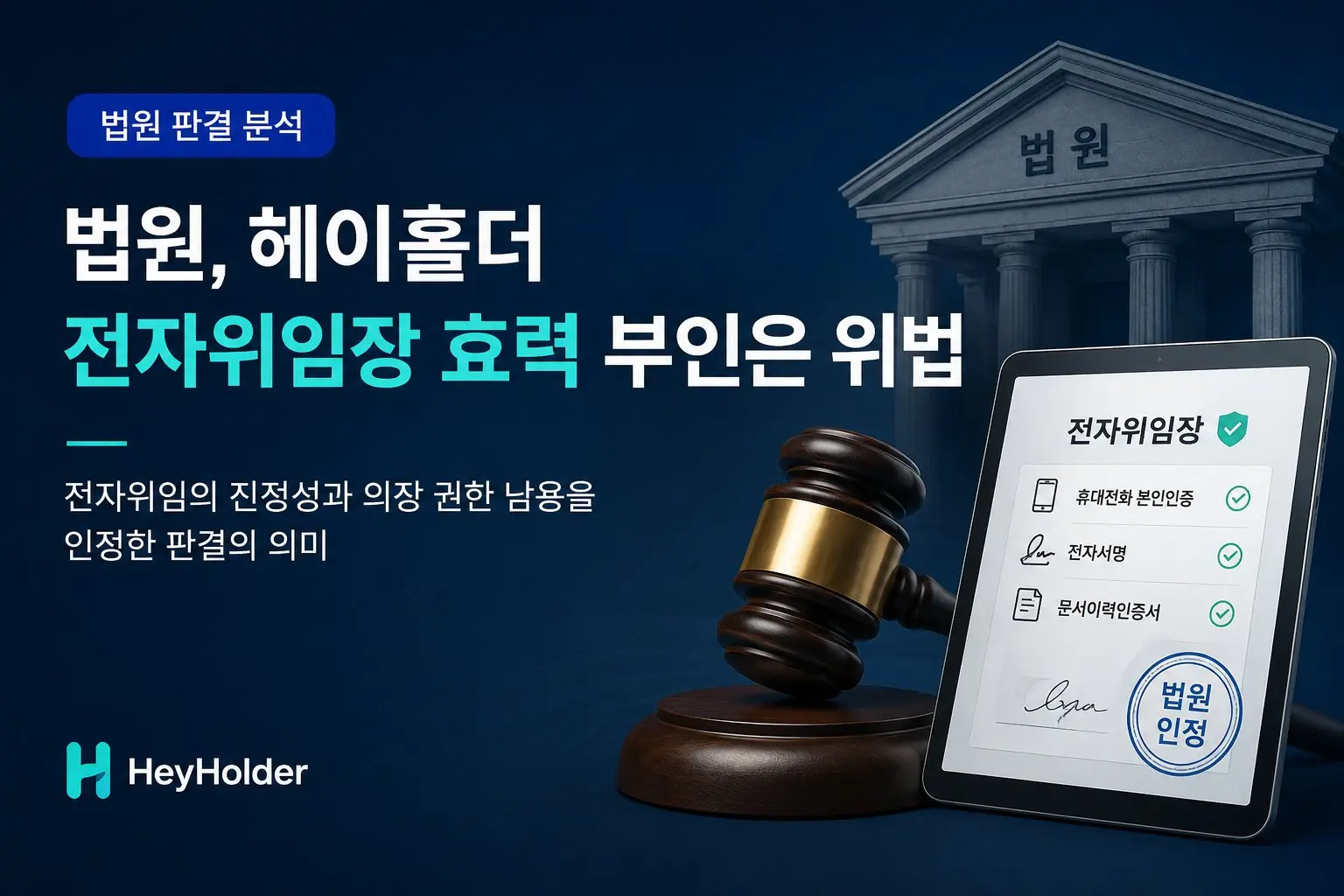
Court Rules Denial of Validity of HeyHolder Electronic Proxies Was Unlawful
2026-07-30
Significance of the Ruling Recognizing the Authenticity of Electronic Proxies and the Chair's Abuse of Authority
On July 24, the Seoul Southern District Court held that the resolution amending the articles of incorporation to tighten the eligibility requirements for auditors was void, on the grounds that it was unlawful for Infinitt Healthcare to categorically deny the validity of the electronic proxies submitted by the minority shareholders at the extraordinary general meeting of shareholders held on June 23, 2025.
The court further found that the chair's blanket denial of the validity of the electronic proxies was an abuse of the chair's authority and a tort infringing the shareholders' voting rights, and ordered the chair personally to pay compensation for emotional distress of 30 won per share held by the shareholders.
The validity of electronic proxies as such was already recognized by a court last year. The key point of this ruling is that it goes one step further and squarely recognizes the validity of electronic proxies that went through mobile phone identity verification and electronic signature without attaching a copy of an ID.
Existing electronic proxy platforms require a copy of an ID to be attached to verify the identity of the principal. This approach not only carries a high risk of personal data leakage but is also cumbersome, acting as a considerable obstacle to many shareholders' participation in electronic proxy voting. HeyHolder, by contrast, adopted a simple method that does not collect copies of IDs and instead verifies the principal's identity through mobile phone identity verification and electronic signature.
Regarding precisely this method, the court held that a document history certificate recording the mobile phone subscriber's name and phone number, the identity verification details, the time of verification, the IP address, and the time the proxy was created is sufficient by itself to recognize the authenticity, identity, and integrity of the electronic proxy.
Recognition of the Chair's Personal Liability for Damages
In practice, there have been quite a few cases in which the validity of properly submitted proxies was unjustly denied on the ground that the chair of a general meeting of shareholders has the primary authority to decide whether to recognize voting rights.
This ruling judicially confirmed that it was unlawful for the company to arbitrarily disregard the validity of electronic proxies lawfully obtained by minority shareholders, and recognized the chair's personal liability for damages.
This is regarded as an important precedent confirming that if a company's management uses its authority to review proxies or the authority of the chair of a general meeting of shareholders to arbitrarily exclude minority shareholders from exercising their voting rights, it may bear civil liability for damages as well.
Ongoing Lawsuits and Outlook
Separately from this ruling, three major lawsuits concerning Infinitt Healthcare are currently pending. The first is a damages claim against Chairman Hong Ki-tae over the unlawful payment of management advisory fees; the second is a lawsuit seeking the removal of Chairman Hong Ki-tae; and the third is a damages claim filed by Infinitt Healthcare against its former CEO.
All three of these cases are expected to conclude oral arguments in September to October, and judgments are expected to be issued in the second half of this year.
In particular, these lawsuits are set to decide in earnest whether the management advisory fees totaling 16.3 billion won that Infinitt Healthcare paid to its parent company, Solborn, from 2016 to 2024 were lawful, and whether it was legally justified for the company to file a damages lawsuit against its former CEO last year even at the cost of a trading suspension.
Accordingly, these judgments are expected to set important standards for Infinitt Healthcare's corporate governance and management accountability, and are drawing close attention.
Future Shareholder Action Plans
Citing this ruling, the minority shareholders stated that they plan to pursue again the convening of an extraordinary general meeting of shareholders with the removal of the auditor and the appointment of a new auditor on the agenda.
Previously, in response to the minority shareholders' request to convene a meeting, the company held an extraordinary general meeting of shareholders in June last year, but because it categorically denied the validity of the electronic proxies submitted by the minority shareholders, the auditor removal proposal put forward by the minority shareholders was rejected. The minority shareholders subsequently requested the convening of another extraordinary general meeting on the ground that the company's refusal to recognize the electronic proxies was unlawful, but during the proceedings some shareholders disposed of their shares and the group no longer met the statutory minority shareholder requirement, so that lawsuit was withdrawn.
They later requested the convening of an extraordinary general meeting once more on the same agenda, but the court at that time dismissed the request on the ground that it was difficult to conclude that the company's refusal to recognize the electronic proxies was unlawful.
However, since this ruling has judicially confirmed that the company's blanket denial of the validity of the electronic proxies was unlawful, the minority shareholders take the position that the need to convene an extraordinary general meeting again has become all the clearer. Accordingly, they stated that they plan to resume the procedure for convening an extraordinary general meeting to remove the auditor and appoint a new one.