


What Percentage Does It Take to Win a Board Seat?
2026-09-07
September 10: How Mandatory Cumulative Voting Changes the Math
On September 10, 2026, listed companies with total assets of 2 trillion won or more will no longer be able to exclude cumulative voting through their articles of incorporation. A provision that has been close to a dead letter for 28 years since its introduction in 1998 will finally take effect for the first time, as most listed companies lose the exclusion clauses they had written into their articles.
But ordinary shareholders who hear this news are really asking a different question: “So what can I actually do with my stake?” This article tries to answer that question with numbers.
1. What Changes on September 10
• Large listed companies with assets of 2 trillion won or more can no longer exclude cumulative voting through their articles of incorporation. This also applies to companies that already have an exclusion clause.
• The number of audit committee members who must be elected separately expands from one to two.
• Since July 23, the ‘combined 3% rule’ has already been in effect. Under this rule, when audit committee members are elected, the voting rights of the largest shareholder and its related parties are added together and recognized only up to 3%.
Cumulative voting does not happen automatically. A shareholder has to request it. Under Article 542-7 of the Commercial Act, shareholders holding at least 1% of the total issued voting shares must submit the request in writing or electronically at least six weeks before the date of the general meeting. For most listed companies, the effects of this system will most likely first become fully visible at the 2027 annual general meetings. Legally, however, it applies from the first shareholders' meeting convened to elect directors after September 10, 2026. Companies that hold an extraordinary general meeting first may therefore see it apply as early as 2026.
2. How Is the Required Shareholding Calculated?
In cumulative voting, each shareholder's number of votes equals the number of shares held × the number of directors being elected this time, and all of these votes can be cast for a single candidate. This works because candidates are not voted on one by one. Instead, all candidates are considered together, and the winners are determined in order of votes received.
Suppose a company with 100 issued shares is electing three directors. A, who holds 26 shares, has 78 votes, and B, who holds 74 shares, has 222 votes. If A casts all 78 votes for one candidate, B would need to give each of its three candidates 79 votes (237 in total) to block that candidate, but B has only 222 votes. With 26%, A secures one board seat against a 74% holder.
Required shareholding = number of directors to secure ÷ (number of directors being elected this time + 1)
At this point, most people react the same way: “If electing a single director through cumulative voting takes as much as 25%, isn't it practically meaningless?” That may be a fair point, but this calculation is missing a variable. The denominator is not the total number of issued shares but the voting rights actually exercised by shareholders present on the day of the general meeting. Shareholders who do not attend the general meeting cast no votes at all.
Required shareholding = attendance rate × number of directors to secure ÷ (number of directors being elected + 1)
Let's check the math. Take a company with 10 million issued shares that is electing five directors, with 7 million shares present. If a coalition of ordinary shareholders gathers 12% (1.2 million shares), it has 6 million votes. The controlling shareholder side has 29 million votes. However, to push all five of its candidates above 6 million votes, it would need 30 million votes, leaving it 1 million votes short. No matter how it distributes its votes, it cannot prevent the coalition's candidate from being elected. Once the threshold is crossed, the outcome is locked in regardless of the other side's strategy. This is why cumulative voting is described as a ‘guarantee.’ With attendance rates factored in, these thresholds are summarized below.
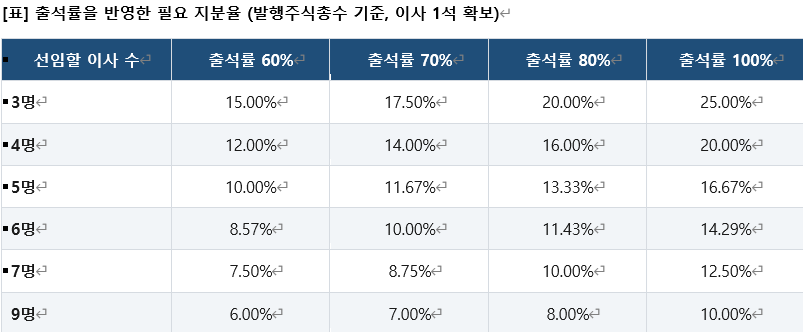
At a company electing seven directors with 70% attendance, 8.75% is enough to secure one board seat. The cell matching the conditions in the check above (five directors, 70% attendance) shows 11.67%, so the coalition's 12% had cleared that threshold.
3. But Companies Have Already Adjusted the Denominator
Looking at the table again, the most powerful variable behind the required shareholding is not the attendance rate but ‘the number of directors being elected this time.’ In the 70% attendance column, the threshold is 8.75% with seven directors, but it doubles to 17.50% when the number falls to three. Companies know this very well.
Two kinds of amendments to the articles of incorporation already appeared at the 2026 annual general meetings. The first sets a cap on the number of directors, which reduces how many directors are elected at one time. The second introduces staggered terms by adding a clause stating that “terms may be set differently for each director,” which spreads out when terms expire. Even with nine directors, if only two or three terms expire each year, only two or three directors are elected at each general meeting. Taiwan made cumulative voting mandatory in 2012, and the number of directors nominated by minority shareholders surged at first. It later declined as companies responded with measures such as shrinking their boards.
What stands out is that these proposals actually passed. Align Partners' analysis of the 2026 annual general meetings shows that this trend was substantial. Among KOSPI 200 companies, 21 put forward proposals to change director terms from ‘three years’ to the more flexible ‘up to three years,’ and 95% of them passed. Proposals to reduce the number of directors or cap board size were put forward at 25 companies, and 92% of them passed. These amendments are not unlawful in themselves. However, they can weaken the effect of cumulative voting by reducing the number of directors elected at a single meeting or by spreading out when directors' terms expire. It is also worth noting that most of these proposals passed even though the National Pension Service and domestic proxy advisors opposed many of them.
The contest did not begin with the director election proposals at the March meetings. It had already begun earlier, with the proposals to amend the articles of incorporation.
4. A Lower Threshold Lies in the Audit Committee
If the numbers in the table still look daunting, there is another route with a fundamentally different threshold: separately elected audit committee members. In this vote, the largest shareholder and its related parties have their combined voting rights recognized only up to 3%. Even a controlling shareholder with a 45% stake becomes a 3% shareholder. If the company has adopted electronic voting, an audit committee member can be elected by a simple majority of the voting rights of shareholders present, without the requirement of one-quarter of total issued shares (Article 542-12, Paragraph 8 of the Commercial Act).
For ordinary shareholders, the realistic first target is not the board of directors but the audit committee. However, practitioners disagree on whether cumulative voting applies to the election of separately elected audit committee members, and this issue needs to be settled before the 2027 general meetings.
5. Four Things to Check Now
• Do the company's total assets exceed 2 trillion won? Mandatory cumulative voting and the separate election of two audit committee members apply only to companies above this threshold.
• Have defensive provisions been added to the articles of incorporation? Look for caps on the number of directors and clauses allowing different terms. It is worth comparing the articles before and after any amendments made since March 2026.
• How many directors' terms expire at next year's general meeting? This number is the denominator in the table, and it can be counted from the executive status section of the business report.
• Have you counted back from the six-week deadline? If the previous year's annual general meeting was held in late March, the deadline for requesting cumulative voting will generally fall in early to mid-February. That leaves about five months to prepare.
The 8.75% and 11.67% in the table are not thresholds that any single individual can cross. Cumulative voting only makes it possible to pool scattered shares behind one candidate. The work of pooling them still falls to shareholders. Seven days from now, the provision will come to life after 28 years, and companies have already amended their articles and finished preparing. Now it is ordinary shareholders who need to prepare.